Health Systems Education · Movement System · Guide 1
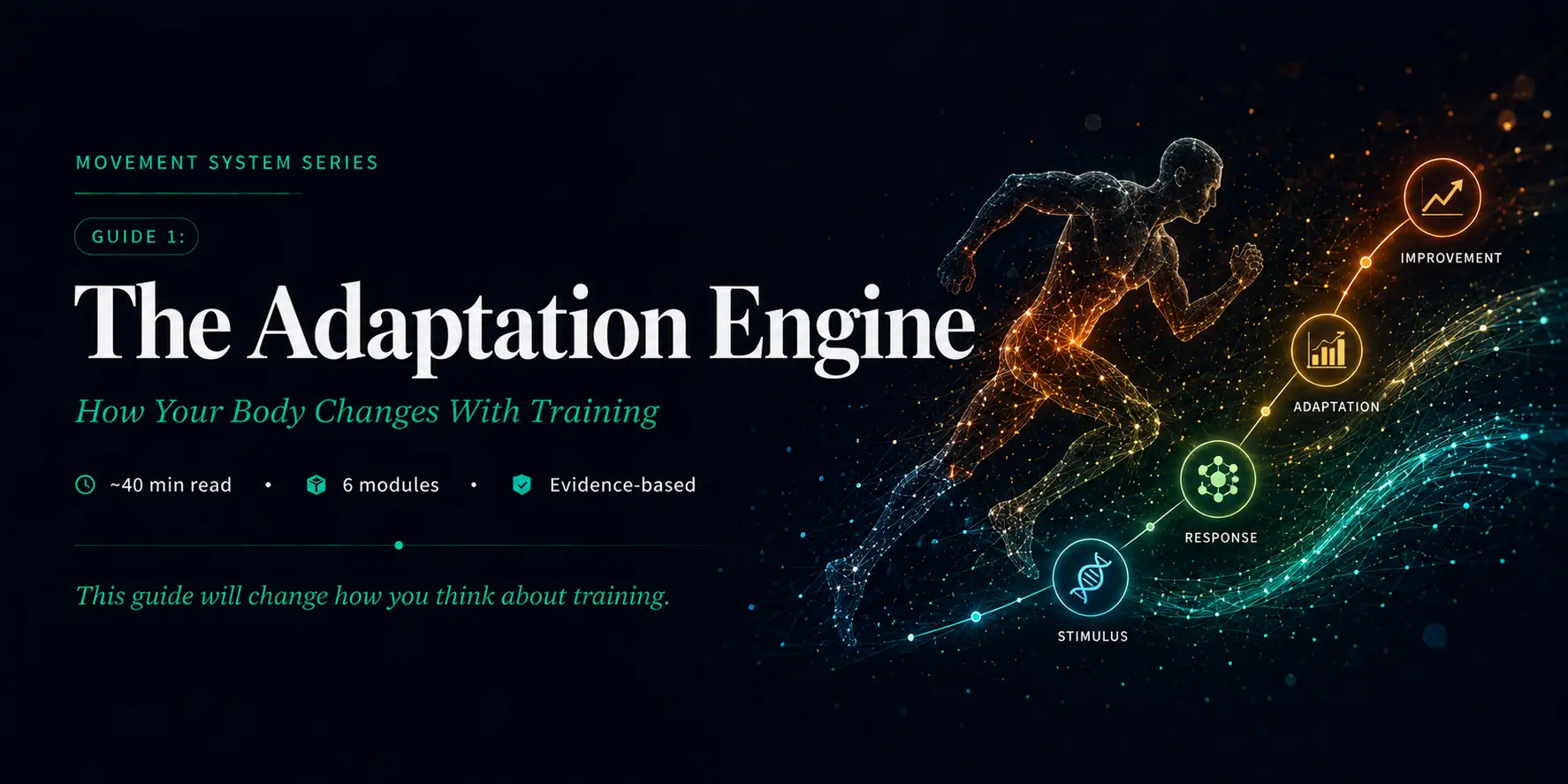
The Adaptation Engine
Six principles govern every result you've ever gotten from training. Understand them, and every training decision finally makes sense — for your body, your goals, your life.
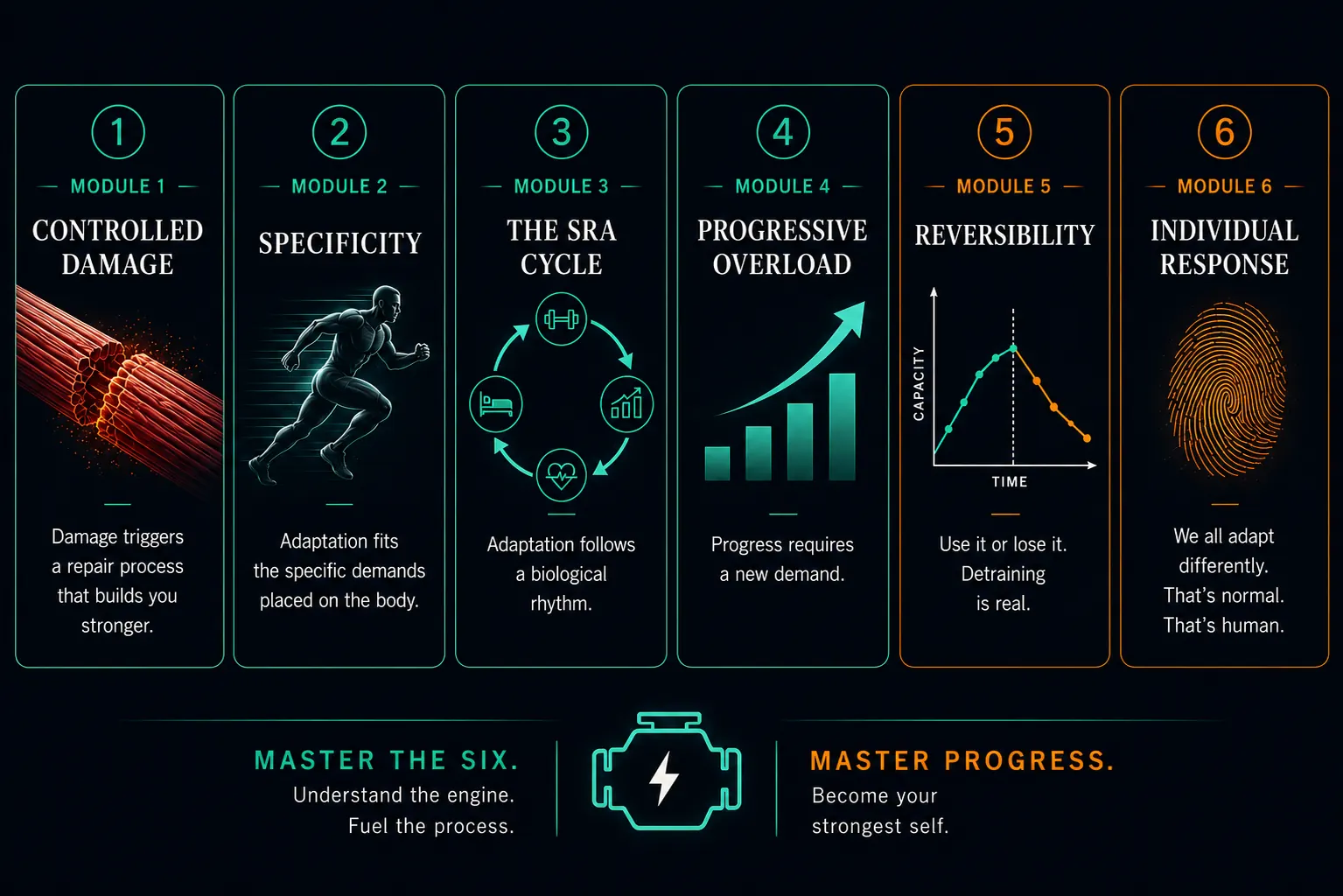
Introduction + Module 1, free. No signup.
Have You Ever Wondered...
Should I train every day or let my muscles recover?
Is soreness a sign of progress or overtraining?
Why does this programme work for some people but not me?
Does it matter which muscles I train on which days?
How much training is too much — or not enough?
Can I build strength and endurance at the same time?
These aren't beginner questions. They're conversations people have in gyms, homes, and with friends every day. The Movement System guides give you a clear way to think about them.
You don't need a science background. You don't need to train at an elite level. You just need curiosity about how your body responds to what you're doing.
The Adaptation Engine answers all six. Read the introduction and Module 1 free.
Most people experience their body reactively — through soreness, fatigue, results, and setbacks. Very few are taught to see it as a system with discoverable rules.
The body adapts according to biological principles whether you understand them or not. Training without that understanding means reacting to outcomes. Training with it means working with your biology deliberately.
That is the distinction this platform exists to close. Not faster results. Not better programmes. Understanding — so that every training decision you make is grounded in how your body actually works.
The goal is not dependence on programmes. The goal is autonomy.
What You'll Walk Away With
Most fitness content tells you what to do. These guides teach you how to think — so you can make intelligent training decisions for yourself.
How It Actually Works
Understand training from cellular mechanisms to practical programming. No black boxes — just clear cause-and-effect relationships.
Decision Tools, Not Templates
Learn to evaluate any approach, design training that fits your context, and make decisions based on biological principles — not borrowed authority.
Science Made Clear
Scientifically rigorous yet accessible. The sweet spot between academic textbooks and oversimplified advice.
Training for Life, Not Just Now
From youth through masters athletes. Understand how training changes across decades and train intelligently at every age.
Training Autonomy
Stop depending on external authority for every training decision. Understand the principles well enough to evaluate any approach — and design one that fits your biology, your goals, and your life.
Knowledge That Compounds
Unlike a programme that expires when you finish it, principle-level understanding builds over time. Every training decision you make is informed by what you learned here.
Introduction + Module 1, free. No signup. The full guide unlocks for $10.
Scientifically responsible, pedagogically coherent, practically useful, and philosophically complete.
— Independent Expert Review
The introduction and Module 1 are yours immediately. The full guide is one decision away.
Begin Reading
Start free. Read the introduction and Module 1. If it changes how you think about training, unlock the remaining five modules.
Introduction + Module 1 — Controlled Damage
The foundation of everything that follows. Why training is strategic destruction, how damage becomes the signal to adapt, and the line between a signal and an injury. Read it in full, free.
Begin Reading →Free
No signup required
Continue the Guide
Unlock Modules 2–6
Specificity, the SRA Cycle, Progressive Overload, Reversibility, and Individual Response — the five modules that turn the foundation into a framework you can apply to your own training. One purchase. Instant access.
One System. Five Guides.
The Adaptation Engine is the first of five guides. Each follows the same promise: Module 1 free, the full guide for $10. Released one at a time.
Guide 1 · Available now
The Adaptation Engine
How your body changes with training — the six principles behind every result.

Guide 2 · Releasing next
Energy Systems
The three fuel systems that power every effort — and why each trains a different athlete.
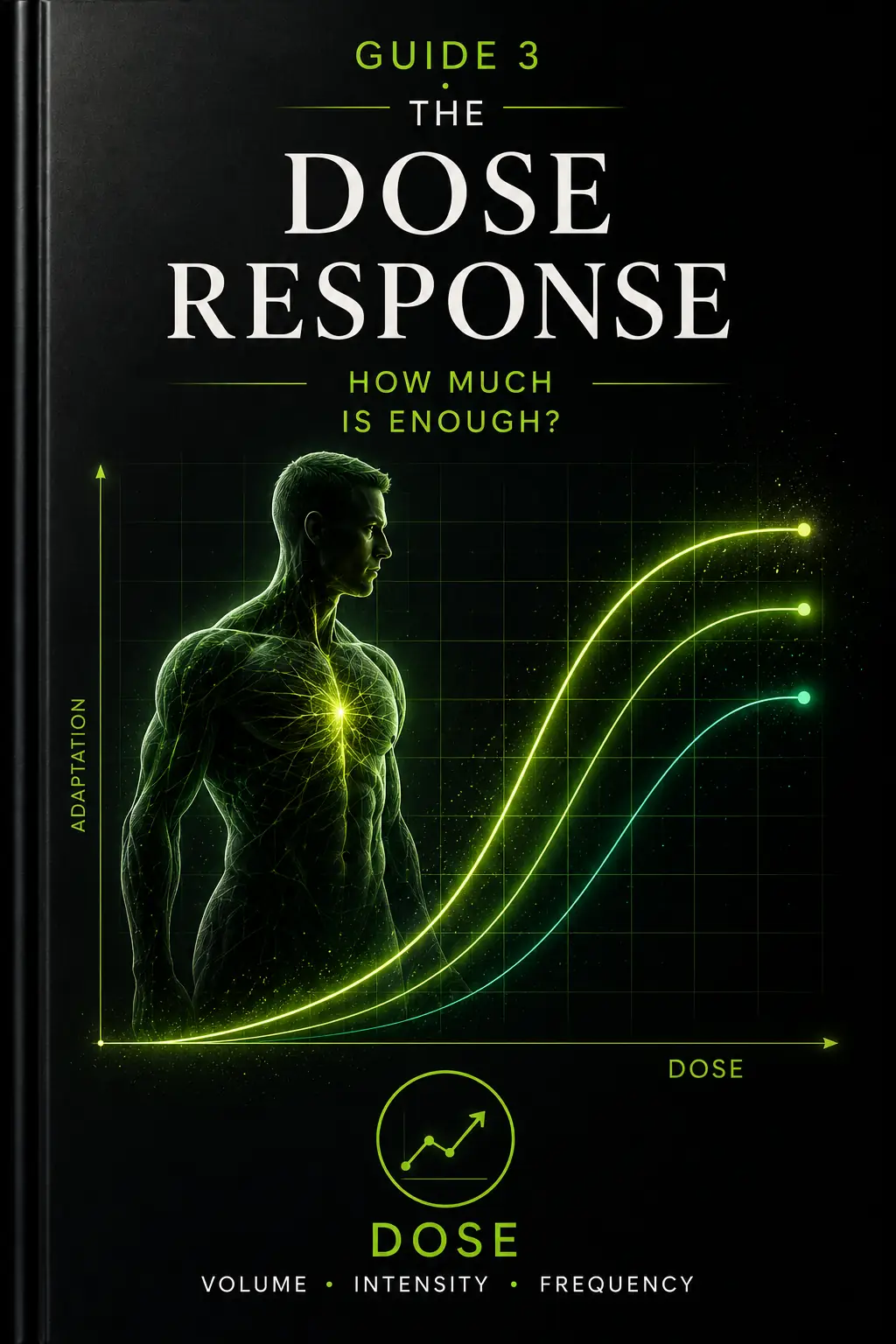
Guide 3 · In the series
Dose-Response
How much training is enough — volume, intensity, frequency, and when more becomes less.
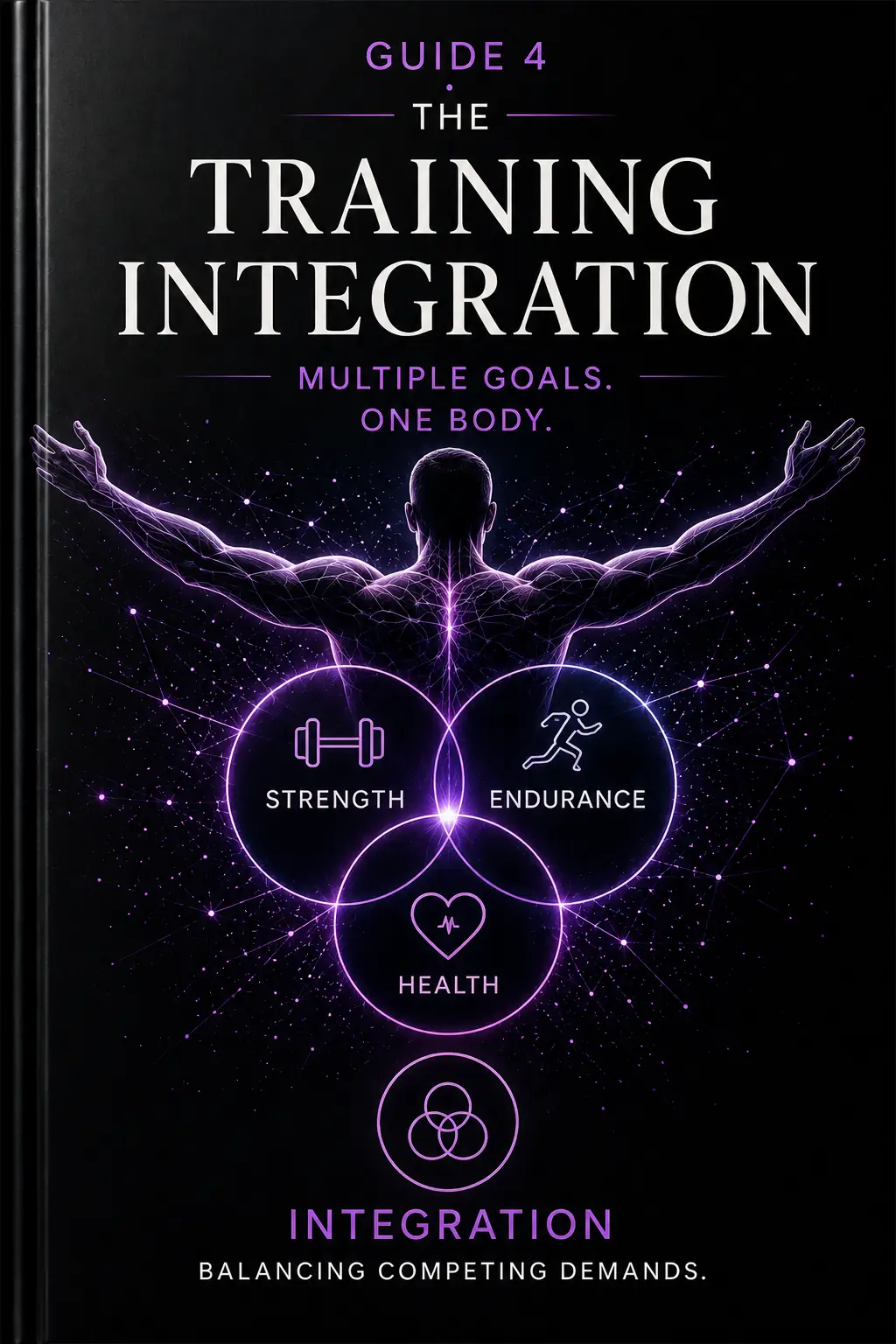
Guide 4 · In the series
Training Integration
Multiple goals, one body — how to combine strength, endurance, and recovery coherently.

Guide 5 · In the series
Lifespan Adaptation
How training principles evolve with you — from youth through the master years.
Six modules on how your body changes with training. Module 1 is free. The full guide unlocks for $10.

Free


The Adaptation Engine
How Your Body Changes With Training
What happened?
You didn't just get stronger. Something changed. The mechanism is both simple and profound: you damaged your body, and it adapted to prevent that damage from happening again.
This isn't a metaphor. Training literally creates controlled damage — and your body's response to it is what we call adaptation. Understanding this process is the foundation of intelligent training.
Six principles govern every training result you have ever experienced.
- 01Training creates controlled damage that signals the need for change.
- 02Adaptations are specific to the exact stress you impose.
- 03Adaptation occurs in predictable phases with critical timing windows.
- 04Continued progress requires systematically increasing demands.
- 05Adaptations fade without continued stimulus.
- 06Your individual biology determines how you respond.
Master these, and you understand the mechanisms behind every training outcome — and decide for yourself, from how your body actually works.
Prefer to see the full guide first? View all six modules →

You came to training believing it builds you. It doesn't — not directly. Training tears you down on purpose, and the teardown is the instruction your body needs to come back stronger. The damage is not a side effect. It is the message.
If that sounds backwards, it is — and it is the most important reversal in this guide. Once you see training as deliberate, controlled destruction rather than construction, almost every confusing thing about progress, plateaus, and recovery starts to make sense. So before we go anywhere else, we have to understand the damage itself: what it is, why it helps, and where the line falls between the damage that builds you and the damage that breaks you.
Start with something you have already lived. Think of how skin adapts to friction. Use a shovel for an afternoon and the soft skin of your palm blisters and tears. Use it regularly, and something different happens — the skin thickens into a callus, tougher and more resistant than before. The friction damaged the outer layer, and your body responded not by simply repairing it, but by building something stronger than what was there. No friction, no callus. The skin had no reason to change until the demand made its current state inadequate.
That same logic governs bone, tendon, muscle, heart, and nervous system. Every tissue you train follows the pattern you can see in your own hands.
Look closely at the final stage. The body did not simply return the bone to its original state — it rebuilt it stronger and more resilient than before, reinforced against the very stress that damaged it. This is the single most important idea in the module: biological systems do not merely repair, they overcompensate. Faced with a demand that exceeded their capacity, they rebuild past the old ceiling so the same demand will not threaten them again. That overshoot is adaptation. Everything you have ever gained from training — every kilogram added, every mile made easier — is a record of your body overcompensating for damage it decided it could not afford to repeat.
But why does the body wait for damage at all? Why not simply build a strong, resilient body and keep it? Because strength is expensive. Muscle is metabolically costly to carry and maintain; denser bone, larger hearts, deeper energy reserves all demand resources the body would rather conserve. Evolution did not shape us to be as strong as possible — it shaped us to be as strong as necessary, and no stronger. A body that built capacity it never used would be squandering energy it might need to survive.
So your body holds to a strict rule: it does not invest in capacity until the current capacity proves insufficient. Damage is the proof. When tissue is damaged by a demand it could not meet, that damage is the unambiguous signal that the present structure is not enough — and only then does the body authorise the expensive work of building more.
This damage is the signal. It tells your body that current capacity is insufficient — and that it must build more. Remove the damage, and you remove the very message that drives adaptation.
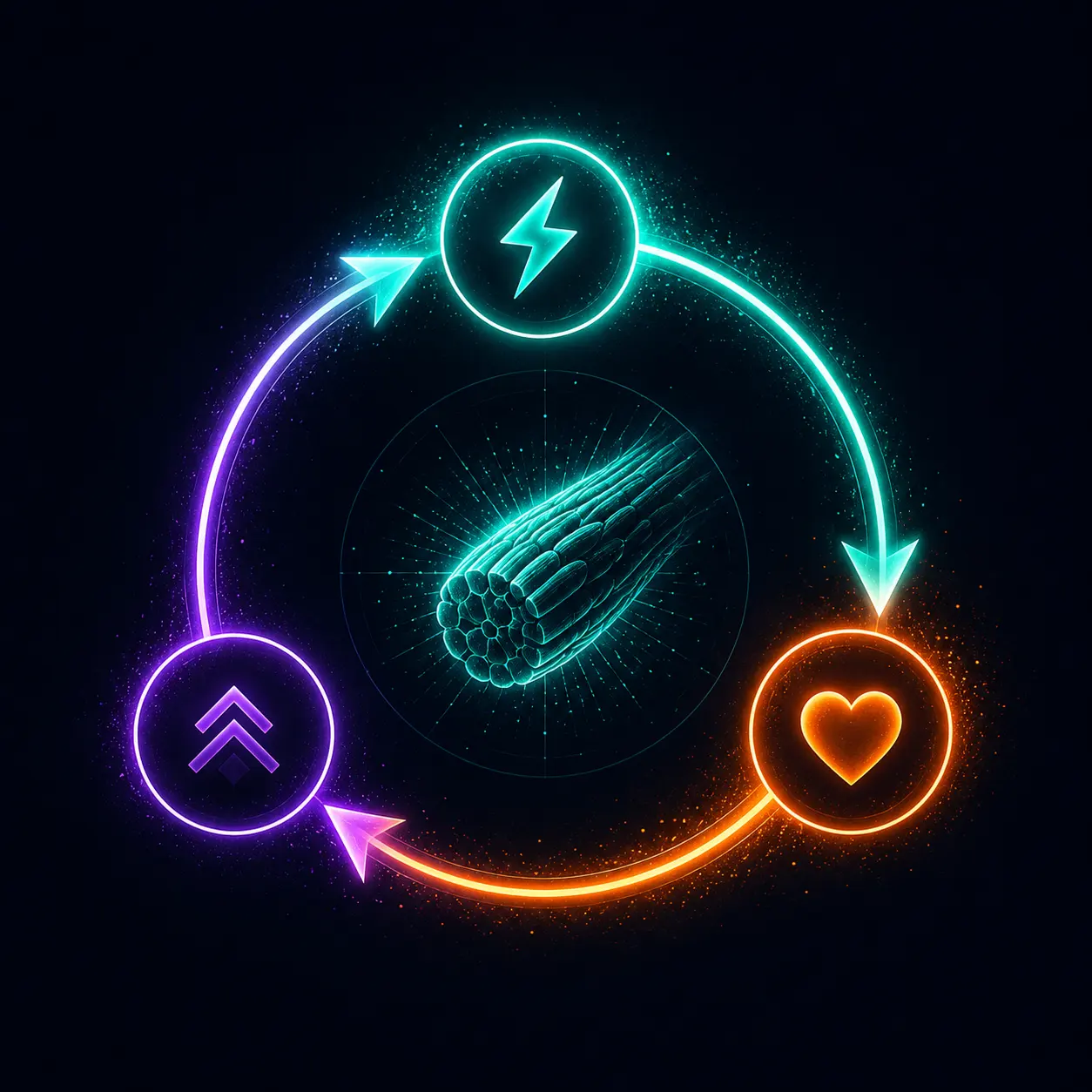
That signal does not arrive by a single channel. Training stresses the body in three distinct ways, and each one generates its own form of damage. Mechanical tension physically tears the contractile proteins inside muscle fibres — the microscopic damage you feel as soreness. Metabolic strain drains the fuel within the cell and floods it with the byproducts of hard work, signalling that the energy systems themselves are inadequate. Neural fatigue degrades the rapid communication between brain and muscle, marking the nervous system as a limiting factor. Three separate mechanisms, arising in three different systems.
Here is what makes this powerful rather than merely complicated: however the stress arrives, the body reads it as the same instruction — current capacity is not enough; build more. You do not have to engineer one specific kind of damage to trigger adaptation. Any sufficient stress, through any of these channels, sends the message. This is why training as different as heavy lifting and hard intervals can both make you fitter: they speak to the body through different routes, but they deliver the same demand. Understanding this frees you from chasing a single "correct" stimulus and lets you see all of training as variations on one biological conversation.
Signal, or Injury?
If damage is the signal, a dangerous conclusion suggests itself: more damage must mean more adaptation. It does not — and this is where most training goes wrong. Damage drives adaptation only up to a point. Beyond it, the same force that built you starts to break you. The difference between the two is not the act of training. It is dose relative to your capacity to recover.
The same session that strengthens a recovered, well-fed, well-rested body can injure a depleted one. The variable is not the weight on the bar or the distance run — it is whether the damage you create stays within the amount your body can repair and then exceed. Below that line, damage is a signal the body answers by building. Above it, damage accumulates faster than repair can keep pace, and the result is not adaptation but breakdown.
This is what the word controlled in "controlled damage" actually means. Not gentle, not minimal — controlled. Damage matched to recovery, applied so the body can answer it. The skilled side of training is not creating the most damage; it is creating the right dose of damage and then giving the body what it needs to overcompensate. And notice where every reliable sign of good training ultimately points: back to recovery. Whether the damage you created becomes adaptation or injury is decided by whether recovery could keep pace with it.
So how do you tell, in your own training, which side of the line you are on? You do not need lab tests — your body reports it plainly if you know what to read. Controlled damage announces itself as soreness that peaks within twenty-four to forty-eight hours and then eases, the feeling of having been worked rather than wrecked, and performance that holds or climbs from one session to the next. Uncontrolled damage reports differently: fatigue that lingers four days or more, sharp or joint-centred pain rather than the dull ache of worked muscle, and performance that erodes week over week no matter how hard you push. The first pattern is the signal being answered. The second is the signal outrunning your capacity to respond — damage accumulating as injury. Learning to read these signs is the difference between training your body and merely punishing it.
That is not a coincidence. It is the next principle hiding inside this one. Training creates the stimulus, but the adaptation itself happens during recovery — not during the work. While you train, you are only creating the damage, only asking the question. The rebuilding, the overcompensation, the actual improvement, all of it occurs afterward, in the hours and days when you are not training at all.
Training is only the question. Recovery is where the answer is built. The improvement you are training for happens when you are not training at all.
Training asks the question. Recovery formulates the answer.

Look at a world-class sprinter: powerful, muscular legs, an explosive frame built for a few seconds of total effort. Now look at a world-class marathoner: lean, economical, almost slight, built to repeat a modest effort tens of thousands of times. Both are runners. Both train with ferocious dedication. Both are among the best in the world at what they do. Yet put them side by side and they barely look like they belong to the same sport.
Why? They both run — so why don't they converge on the same body? The answer is the principle that governs this entire module, and it is more exacting than most people realise: your body does not adapt generally to "training." It adapts specifically to the exact demands you impose on it — and to nothing else.
Specific Adaptation to Imposed Demands. Your body becomes precisely what you repeatedly ask it to become — nothing more, nothing less.
The sprinter's body was never trying to become a runner's body in general. It was answering one specific, relentless demand: produce enormous force, right now, for a handful of seconds. The marathoner's body answered a different demand entirely: sustain a moderate output for hours without failing. Same activity, two different questions — and the body gave two different answers, because it only ever answers the exact question asked.
Your Body Is Ruthlessly Efficient
This precision is not an accident. It is the same metabolic thrift you met in the last module. Building and maintaining any capacity is expensive, so the body refuses to build anything it has not been specifically required to build. Picture adaptation as a target. The bullseye is the exact quality you train. The rings just outside it are closely related qualities that get pulled along a little. And everything beyond the target — the capacities you never demanded — receives nothing at all.
Lift heavy weights for low repetitions and the body builds strength: precisely what the demand called for. It does not also quietly hand you endurance, because endurance was never asked for, and building it unbidden would violate the body's first rule of never spending on capacity it does not need. You get what you train for. You do not get what you trained near.
The Same Movement, Three Different Bodies
If specificity sounds abstract, here is where it becomes concrete and a little startling. Take a single exercise — the back squat — and change nothing about the movement itself. Change only how you load it, and you produce three entirely different adaptations in three different people doing what looks like the same thing.
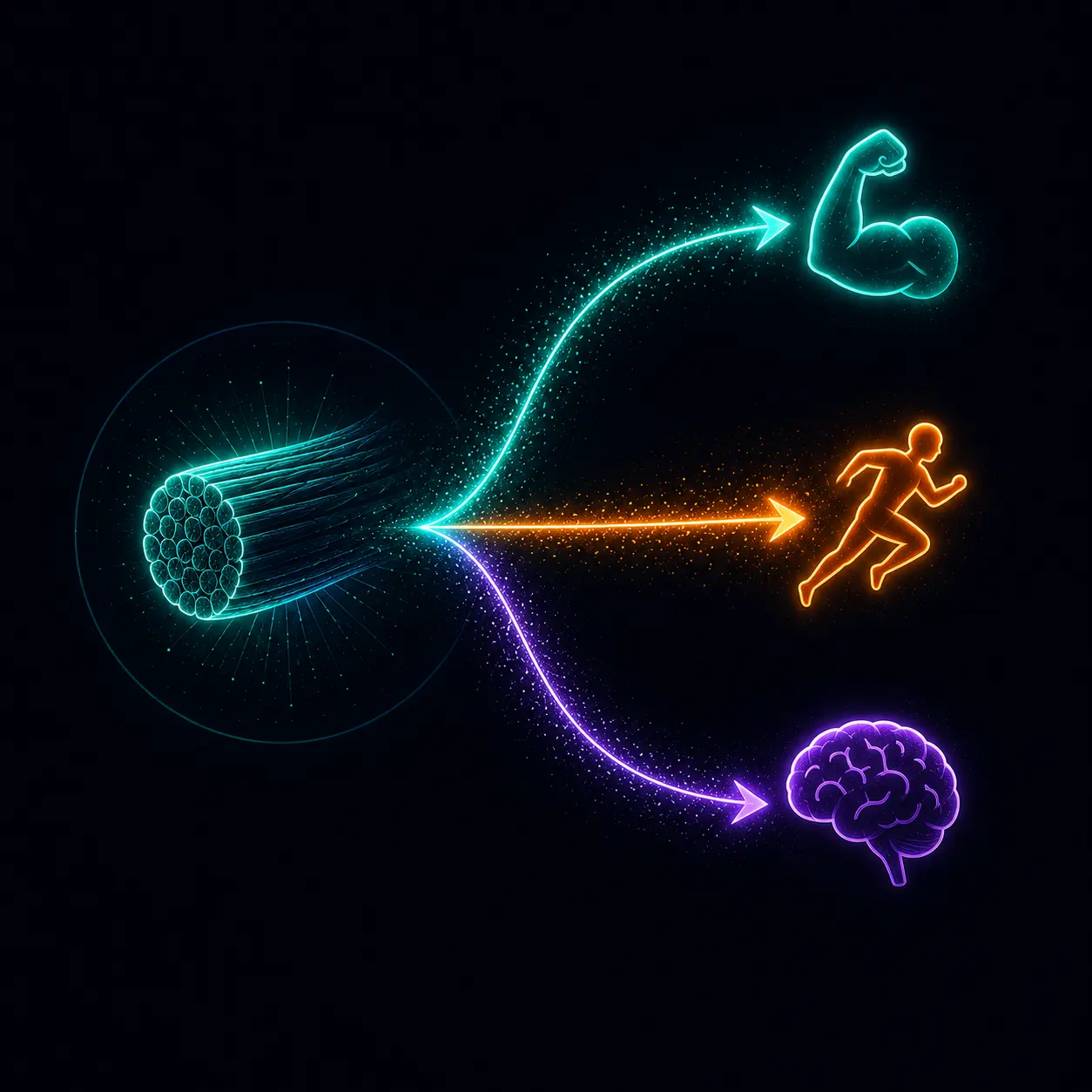
Squat at ninety percent of your one-rep maximum for sets of three, with long rests, and you train strength — the body responds chiefly by improving how efficiently the nervous system recruits and fires muscle, producing more force with little change in size. Squat at seventy percent for sets of ten, with moderate rests, and you train hypertrophy — the body responds by building muscle, growing the fibres themselves. Squat at forty percent for sets of thirty, with short rests, and you train endurance — the body responds by improving the muscle's ability to keep working, building the machinery that resists fatigue rather than the size or force of the muscle. Same bar. Same movement. Three different questions asked of the body, and three different bodies built in answer.
This is the SAID principle made visible, and it carries a consequence most people miss: there is no such thing as training "in general." Every set you perform is a specific instruction. The load, the repetitions, the rest, the speed — these are not arbitrary numbers, they are the language in which you tell your body exactly what to become. Change the numbers and you change the message, even when the exercise on paper stays the same.
The Two Phases of Getting Stronger
Specificity also unfolds over time, and understanding its sequence explains one of the most common sources of confusion for newer trainees: getting visibly stronger in the first weeks without getting visibly bigger. Early adaptation is largely neural. In roughly the first one to six weeks of a new stimulus, the body's first response is not to grow muscle but to use the muscle it already has more effectively — recruiting more fibres at once, firing them faster, coordinating them better. Strength climbs sharply while size barely moves, because the early gains come from learning, not building.
Only when the neural improvements begin to plateau does the body turn to the more expensive work of structural change — enlarging the muscle fibres themselves, thickening tendon, increasing bone density, remodelling the tissue's internal machinery. This is why beginners often feel dramatically stronger within a month while looking much the same, and why visible size takes longer to arrive. The body, ever efficient, exhausts the cheap adaptation before it commits to the costly one.
Before you train, you must answer one question: what specifically am I asking my body to become? Strength, size, endurance, power, skill — each is a different demand requiring a different stimulus. Train for the adaptation you actually want, not the one that is merely adjacent to it.
Your body becomes exactly what you train it to become — nothing more, nothing less.

You complete a hard training session on Monday. Tuesday and Wednesday you are sore and, if anything, weaker than before you started. By Thursday the soreness has faded and you feel yourself again. By Friday — and this is the strange part — you are stronger than you were before Monday's session ever happened.
Nothing about Friday's strength was built on Friday. So what happened across those four days, in which you did no training at all, that left you better than the training itself did? That question is the whole of this module, and its answer overturns the most common assumption in all of training: that you get stronger while you train. You don't. You get stronger afterward. The session is only the trigger. This rhythm — stress, then recovery, then a body rebuilt beyond where it began — is the Stress-Recovery-Adaptation cycle, and it is the engine beneath every result you have ever earned.
Training drives you down first — you end a session temporarily weaker, not stronger. Recovery brings you back up. And if recovery is allowed to finish, the body does not stop at your old level — it briefly overshoots it, leaving you stronger than your starting point. That overshoot is supercompensation, and it is a window, not a permanent step.
Picture it as a wave. Training opens a trough — the dip into fatigue and damage. Recovery is the rising slope out of it. The crest of the wave is supercompensation, the brief peak where you stand above your old baseline. And if no further training arrives, the wave falls again, carrying you back down toward where you began. The entire art of timing your training is the art of catching this wave at its crest.
Most people train too early or too late. Very few train at the peak.
Follow the curve and you can see why timing is everything. The line drops at training, climbs through recovery, crests at supercompensation, then — if nothing renews the stimulus — slides back to baseline. Train again at the crest and your next trough starts from a higher point. Train in the wrong place on the curve and you either dig the trough deeper before you have climbed out, or you wait so long that the crest has already passed. To use this, you first have to understand what is actually happening in each phase.
The Three Phases
The cycle moves through three distinct phases, and each behaves differently enough that confusing one for another is how most training mistakes are made.
Phase 1 — Acute stress. This is the session itself and the hours just after it: the damage phase. Right now, you are weaker than when you started. Performance capacity has dropped, fatigue is high, and that is not a sign of failure — it is the necessary cost of sending the signal. This phase runs from during training to roughly the first day afterward.
Phase 2 — Recovery. This is the phase people misunderstand most, because nothing visible is happening and yet this is where the actual adaptation occurs. Recovery is not passive rest; it is intense biological work. Inflammation rises to direct repair, damaged structures are broken down and cleared, protein synthesis spikes in the first day or two, depleted fuel is restocked, and growth hormone pulses during deep sleep. Its duration is the most variable thing in this module — anywhere from twelve hours to a week or more — and it depends on how much you did, how hard, which tissues you taxed, and on your own age, sleep, and nutrition. Recovery is not a fixed waiting period. It is a process that finishes when the work is done, and not before.
Phase 3 — Supercompensation. When recovery completes, the body does not merely restore what was lost; it builds slightly beyond it. New contractile proteins are laid down, fuel stores are topped past their old ceiling, neural pathways are sharpened, and — if the stimulus was endurance — the muscle's energy machinery is expanded. For a brief window, you are genuinely better than you were. But this is the critical point: supercompensation is a temporary opportunity, not a permanent upgrade. Leave it unused and the elevated capacity quietly drains back toward baseline. The window opens, and then it closes.
The Importance of Timing
Everything above converges on a single practical decision: when do you train again? There are three possibilities, and only one of them produces progress.
Train too soon, before recovery has finished, and you interrupt Phase 2 — you drive a fresh trough before climbing out of the last one. Damage begins to accumulate faster than repair can clear it, and each session starts from a deeper deficit than the one before. The result is stagnation, and eventually overtraining or injury. Train too late, after the supercompensation window has already closed and you have drifted back to baseline, and each session merely returns you to where you started. You maintain, but you never build — endless repetition without development. Train at the crest, during supercompensation, and each session begins from a higher baseline than the last. Progress happens almost on its own, because you are stacking each new wave on top of the previous peak. This single timing decision is the difference between training that compounds and training that runs in place.
You cannot see supercompensation directly, but your body signals readiness. Soreness should peak around twenty-four to forty-eight hours and then resolve. Sleep should be sound, motivation should return, and — the clearest sign of all — a familiar weight should feel easier than it did last time. When the work that challenged you starts to feel light, the window is open.
One reason timing confuses people is that there is no single clock. Different tissues recover on different schedules. Small muscles like the biceps and calves may be ready within a day or two; large muscle groups like the quadriceps and hamstrings often need two to three days; and the nervous system, taxed by heavy squats and deadlifts, can take three to four days — stretching to five or seven after very high volume or near-maximal loads. This is why intelligent programming does not train everything on the same cycle. The same week that is perfect for one muscle group is too soon for another.
Most people never train in supercompensation. They train in the trough, or they wait until the gains have faded. Timing is the difference.
You now understand the core mechanism behind all training progress.

Imagine performing the exact same workout — same exercises, same weights, same repetitions — every session for six months. What happens? For the first few weeks, progress. Then, slowly, nothing. You have not lost ground; you can still do the work. But you have stopped improving. The weight that once challenged you now merely maintains you.
This is the plateau, and almost everyone who trains hits it. The frustrating part is that it does not feel like you are doing anything wrong — you are working just as hard as before. But "just as hard as before" is precisely the problem. By now you can guess why, because it follows directly from the principle that opened this guide: your body adapts to prevent a given demand from threatening it again — and once it has, that same demand no longer threatens anything.
Systematically increasing the demands you place on your body over time, so that adaptation never stops being necessary.
Why Adaptation Plateaus
Trace what happens to a single exercise over six weeks. In week one, you squat 100kg for eight reps. It is genuinely hard — it creates real damage, real stress, real fatigue, and the body registers the unambiguous message it has learned to act on: current capacity is insufficient. So it adapts. It builds. By week six, that same 100kg for eight reps is comfortable. You have become strong enough that the load no longer exceeds your capacity — and so it no longer sends the signal. No insufficiency, no message; no message, no adaptation. The workout has not changed, but your body has, and the demand that once drove growth now sits comfortably inside your means.
The escape is the entire point of this module: to keep adapting, you must recreate insufficiency — restore the gap between what is demanded and what you can currently do. You must, deliberately and repeatedly, make the work hard again.
This is the cycle the previous module set up, now closed into a spiral. Each turn of stress-recovery-adaptation lifts you to a new baseline — but a baseline is a floor, not a destination. Progressive overload is what you do at that new floor: you raise the demand again, opening a fresh gap above your improved capacity, and the cycle begins anew from higher ground. Each SRA cycle elevates your floor. Progressive overload raises the ceiling. Without it, you simply repeat the same cycle at the same level forever — recovering perfectly from a demand that no longer asks anything of you.
The Ways to Raise the Demand
Here is something that simplifies training enormously: there are only a handful of ways to increase demand, and everything else is a variation on them. Most people reach for one — adding weight — and stall when it stops being possible. But load is only the most obvious lever, and often not the right one.
The most direct levers are the three that change the work itself. Add load — more weight for the same reps, say 100kg × 8 becoming 102.5kg × 8 — which is the cleanest driver of strength when your form is already solid. Add repetitions — the same weight for more reps, 100kg × 8 becoming 100kg × 10 — which builds size and is the natural choice when you cannot yet add load. Add sets — more total volume at the same weight and reps, three sets becoming four — which accumulates the total work that drives muscle growth. These three are where most progression happens, and for most people, most of the time, they are enough.
When those stall, subtler levers remain. Increase frequency — training a movement twice a week instead of once — distributes more total work across the week and sharpens skill through practice. Increase density — doing the same work in less time by trimming rest, three-minute rests becoming two — raises the metabolic demand and builds conditioning. And two levers improve the quality of the work rather than its quantity: greater range of motion (squatting below parallel rather than to it) asks more of the muscle through a longer working range, and better technique or slower tempo (a four-second descent instead of two) increases the genuine demand without touching the weight at all — which is why it is the safest progression for beginners and the rehabilitating.
The practical lesson is not to memorise seven methods. It is to understand that when one avenue closes, several others remain open. A plateau in load is not a plateau in progress — it is a signal to change which variable you are advancing.
Applying It Intelligently
Progressive overload is not a licence to add something every session. It is governed by the same SRA timing — progress belongs at the crest of supercompensation, not before it. When performance feels strong and recovery is complete, that is when you progress. When you are still recovering, you hold steady and let the adaptation finish. And when performance is declining across sessions, the answer is not more but less: you deload, deliberately reducing demand to let accumulated fatigue clear before building again.
This is also why a true stall is usually not a programming problem. When progress stops, the instinct is to change the training — but more often the limiting factor is recovery, not stimulus. Before adding complexity to your program, examine your sleep, your nutrition, and the stress in the rest of your life. The body that will not adapt is frequently a body that is not being given what adaptation requires.
Finally, a reality worth naming plainly: progress is fastest when you are furthest from your potential, and it slows as you approach it. The newcomer who adds weight every week is not doing something the advanced lifter has forgotten — they are simply far from their ceiling, where large gaps are easy to open. As you near your genetic limits, progress becomes slower and harder-won. This is biology, not failure, and understanding it is what separates patient long-term progress from the frustration that ends most training.
Each successful SRA cycle elevates your floor. Progressive overload raises the ceiling.

You have spent six months building strength. Your squat has climbed from 80kg to 140kg — real, hard-won progress. Then life intervenes: an injury elsewhere, a busy stretch at work, a holiday. You take three weeks off.
You come back, load the bar, and the weight that felt routine a month ago now feels impossibly heavy. The strength you built has, in part, slipped away. This is the principle most people discover only by living it, and it is the one that makes training a lifelong practice rather than a project you complete: adaptations are not permanent acquisitions. They are leases — held only so long as you keep paying for them.
Fitness is rented, not owned. Every adaptation you hold is maintained only by continued demand. Stop paying — stop training — and the body begins to repossess what it built.
The curve tells the whole story. Adaptations climb while you train, hold steady while the demand continues, and slide back toward baseline once the stimulus is removed. Notice that the line does not stay at its peak on its own — staying level on the graph still requires ongoing training. There is no flat stretch that happens for free. Every height you reach is held only by continuing to ask for it.
Why Adaptations Don't Persist
By now the reason should feel familiar, because it is the same logic that has run through every module: adaptations are metabolically expensive to maintain. Muscle demands energy, protein turnover, and blood flow merely to be kept. The same thrift that made your body refuse to build capacity until it was forced to also makes it unwilling to maintain capacity it is no longer using. When the demand disappears, the justification for the expense disappears with it, and the body quietly reallocates those resources elsewhere. Reversibility is not a betrayal by your body. It is the exact same efficiency that built you, running in reverse.
What Fades, and How Fast
Not everything is lost at the same rate. The adaptations fade, roughly, in the reverse of the order they were built — and understanding the sequence tells you what a break will actually cost you.
Neural adaptations fade first, within one to two weeks. This is why a short layoff hits so hard and so quickly: the weights feel heavy and awkward, coordination feels slightly off, and strength drops even though your muscle is still entirely there. You have not lost the muscle — you have lost some of the nervous system's skill at using it. Muscular adaptations fade next, on a scale of weeks. Protein synthesis slows, and noticeable atrophy begins around two to three weeks of complete inactivity, with meaningful losses of perhaps ten to fifteen percent possible across four to eight weeks. Metabolic adaptations follow their own schedule: endurance markers like VO₂ max can drop five to ten percent within the first two weeks and fifteen to twenty percent within a month, as the muscle's energy machinery contracts. And structural adaptations fade slowest of all — bone density and tendon strength change over months, not weeks, which means they quietly protect you through short breaks even as faster adaptations slip.
The practical reassurance hidden in this sequence: a short break costs you mostly neural sharpness, which is the fastest thing to fade and the fastest to return. The deep structural foundation you built endures far longer than the surface qualities.
Muscle Memory Is Real
There is a genuine reprieve built into all of this: regaining a lost adaptation is consistently faster than building it the first time. The leading explanation is myonuclear domain theory — the idea that when you build muscle, satellite cells donate nuclei to the muscle fibres, and these nuclei may persist even after the muscle itself shrinks, leaving a kind of dormant infrastructure ready to rebuild. The human evidence is still developing, but the practical observation is beyond dispute: a body that has been somewhere before returns there far more quickly than one arriving for the first time. Where reaching a 150kg squat might take eighteen months the first time, regaining it after a long break may take only six to nine months. Past training is never fully erased. It leaves behind biological infrastructure that makes the road back shorter than the road out.
Holding On During a Break
The most important practical fact in this module is that the binary of "training" versus "not training" is false. You do not need full training to keep most of what you have built — you need far less than people assume, and a little goes a remarkably long way.
The single most effective strategy is to cut volume but keep intensity. You can reduce your training to roughly a third of its normal volume and still preserve most of your adaptations, provided the work you do keep stays genuinely hard — heavy loads, real effort. It is intensity that signals "still needed," not the total amount of work. Even when structured training is impossible, staying generally active matters: any movement beats complete inactivity, and as little as fifteen to twenty minutes, two or three times a week, meaningfully slows the losses. Nutrition does quiet work too — keeping protein high (around 1.6 to 2.2 grams per kilogram of bodyweight) and avoiding a drastic calorie cut helps the body maintain tissue even when training drops off.
And when you return, return gradually. The temptation is to pick up where you left off, but your connective tissue and nervous system need to re-acclimate. Begin at roughly half to sixty percent of your previous intensity and volume for the first week or two, climb to seventy or eighty percent over the next couple of weeks, and only then resume full training. The strength will come back faster than it left — but rushing the return is the surest way to turn a break into an injury.
Fitness is rented. You pay with consistent training — or you vacate.

Same program. Different outcomes.
You and a training partner start the identical programme on the same day. Same exercises, same loads, same progression, same effort. Three months later, they have added fifteen kilograms to their squat. You have added seven. Nothing differed in the training — and yet your bodies answered the same question with different answers.
This is the principle that completes the guide, and it resolves a tension that has been quietly present in every module so far. You have learned that the principles of adaptation are universal — damage signals, specificity, the recovery window, progressive overload, reversibility apply to every human body without exception. And yet the results they produce are stubbornly individual. The explanation is that the same universal principles run through different hardware. Your genetics, your training history, and your present circumstances all shape how your particular body responds to demands that would be identical on paper.
The diagram captures the whole shape of it: you bring a unique starting point, the same stimulus produces a response scaled to your biology, and your task is to observe that response and adjust your approach to fit it. The principles do not bend for you — but how you apply them should.
The Biology You Did Not Choose
Some of what shapes your response was decided before you ever trained, written into your physiology. Four factors matter most.
Muscle fibre type. Your muscles are a mix of slow-twitch fibres, which resist fatigue and favour endurance, and fast-twitch fibres, which produce power but tire quickly — and the ratio is substantially genetic. Someone weighted heavily toward slow-twitch fibres will take naturally to endurance and build maximal strength more slowly; someone weighted toward fast-twitch will gain strength readily and find high-repetition endurance work harder. Neither is better. They are simply suited to different demands — a direct, personal instance of the specificity you met in Module 2.
Hormonal response. The same workout triggers a larger and more sustained anabolic hormonal response in some people than others. A so-called high responder produces a strong, lasting hormonal signal with modest stress hormones, and grows and recovers quickly; a low responder gets a smaller, briefer signal and needs more recovery for less return. This is one of the largest hidden reasons two people on the same programme diverge.
Leverage. Strength is not muscle alone — it is muscle acting through your skeleton. Limb lengths and the points where tendons attach to bone give some people a mechanical advantage in a given lift that has nothing to do with how much muscle they carry. Two people with identical muscle can lift very different weights, which is precisely why comparing the number on the bar against someone else's tells you little about your own progress.
Recovery capacity. The recovery window from Module 3 is not the same width for everyone. Some bodies are ready again within forty-eight hours; others need three or four days for the same stimulus, governed by differences in protein synthesis, inflammation, and nervous-system baseline. The same programme that is perfectly timed for one person trains another straight into the trough.
What History and Circumstance Add
On top of the biology you were given sits the question of where you currently stand. Training history sets your distance from your own ceiling — and this is the diminishing returns from Module 4 made personal. A beginner sits far below their genetic potential, so almost any reasonable stimulus produces substantial gains. An intermediate is closer and needs more deliberate programming. An advanced trainee, perhaps eighty to ninety percent of the way to their ceiling, must execute precisely to earn small improvements. The same programme that transforms a beginner barely moves an advanced lifter — not because it stopped working, but because they have less room left to grow.
And around all of it sits your present context, which can amplify or suppress everything else. Sleep is the clearest lever: a full night supports adaptation, while chronically short sleep impairs it no matter how good the training. Nutrition sets the raw material — adequate fuel and protein enable growth; a steep deficit starves it. Life stress tips the body between a building state and a breaking-down one. And age shifts the whole picture, with younger bodies recovering faster and older athletes rewarded for more conservative, well-recovered programming. None of these change the principles. All of them change the response.
How you respond to any programme is the product of three things: your genetics, your training history, and your current context. Change none, one, or all — but know which is which.
Optimise What You Control. Accept What You Don't.
Here is where this module becomes the quiet heart of the entire guide. Lay the factors side by side and they sort cleanly into two columns. On one side sit the things you cannot change: your fibre-type ratio, your hormonal responsiveness, your leverages, your age, and the distance you have already travelled from your starting point. Spending energy resenting these is spending it on the immovable.
On the other side sit the things fully within your control, and they are more powerful than the fixed factors get credit for: the effort you bring and the intelligence with which you train; your recovery — sleep, nutrition, stress — which we have seen is where adaptation actually happens; the choice to match your programming to your own response rather than someone else's; and the patience to progress at your own rate. The entire practice of intelligent training is the discipline of pouring your attention into that second column and refusing to spend it on the first.
You cannot change the hand you were dealt. You have near-total control over how well you play it. Optimise relentlessly what you can control; accept gracefully what you cannot. That is not a consolation — it is the whole strategy.
And it leads to the most freeing idea in this guide. Once you understand that your response is yours alone — shaped by a biology and a history no one else shares — comparison to other people stops making sense. Their results were produced by their hardware answering their circumstances. Yours are the only ones that were ever available to you, and the only ones worth measuring against your own past.
Stop comparing your chapter three to someone else's chapter twelve.
Everything Connects.
Six principles. One unified framework. Each one incomplete without the others.
Integration: The Adaptation Engine in Action
These six modules are not separate. They operate together.
You now understand the six principles that govern all training adaptation:
- Controlled Damage signals the need for change
- SAID Principle determines what changes occur
- SRA Cycle determines when changes occur
- Prog. Overload ensures changes continue
- Reversibility requires ongoing stimulus to maintain changes
- Individual explains why changes vary between people
Together, these form the Adaptation Engine:
You impose controlled damage (1) that's specific to your goals (2), recover and supercompensate on an individual timeline (3), progressively increase demands over time (4), maintain adaptations with continued stimulus (5), all while recognising your response is uniquely yours (6).
This is the foundation of intelligent training.
The Movement System Doesn't Operate in Isolation
Every principle requires support from other systems:
- Controlled damage requires Fuel (energy for work) and Recovery (sleep for repair)
- Specific adaptations require Structure (joints that tolerate load) and Signal (hormonal environment for growth)
- SRA timing depends on Recovery capacity and Signal balance
- Progressive overload needs Fuel to support increased demands
- Reversibility accelerates with poor Recovery and dysregulated Signal
- Individual response is modified by Fuel quality, Recovery capacity, Structure limitations, and Signal optimisation
You cannot optimise the Movement System without optimising all five systems.
This is systems thinking: recognising that training outcomes are determined by the integration of all systems, not the perfection of one.
What You Now Understand
You now understand how your body adapts.
You've learned the fundamental principles of how training creates adaptation. You now know:
- How training damage signals biological change
- Why different training creates different adaptations
- When adaptation occurs and how to time your training
- How to ensure continued progress over months and years
- Why adaptations fade without maintenance
- Why your results differ from others and what you can control
You understand the mechanisms that govern training adaptation.
What You Can Now Do
With this foundation, you can:
- Predict adaptation outcomes from training stimuli
- Design training matched to specific goals
- Adjust training when life circumstances change
- Recognise when progress stalls due to recovery, not programming
- Make informed decisions based on biological principles
- Think in systems, not protocols
This is training autonomy.
Moving Forward
The Adaptation Engine is Guide 1 of the Movement System. The principles you've learned here form the foundation for everything that follows:
- Guide 2 — Energy Systems: how your body powers every movement
- Guide 3 — Dose-Response: how dosage determines adaptation magnitude
- Guide 4 — Training Integration: how to train multiple qualities simultaneously
- Guide 5 — Lifespan Adaptation: how training changes across the lifespan
Understanding enables autonomy. Principles are permanent; methods evolve.
This is not the end of your learning. It's the beginning of your autonomy.
Understanding enables autonomy. Principles are permanent; methods evolve.
The Adaptation Engine is Guide 1 of 5. The principles you have learned here form the foundation for everything that follows.
Coming Next · Guide 2 of 5
Energy Systems
How Your Body Powers Movement
You now understand how your body adapts. Guide 2 answers the question underneath every session: where does the energy actually come from?
Releasing next in the Movement System · ~40 min read · 6 modules