Why can I sprint for ten seconds but jog for an hour?
Health Systems Education · Movement System · Guide 2
Energy Systems
Three systems power every movement you make. Understand them, and you understand why a sprint and a marathon feel like different bodies — and how to train the one you actually want.

Introduction + Module 1, free. No signup.
Have You Ever Wondered...
What actually causes the burn in a hard set?
Is lactate really what makes me sore and tired?
Why do sprinters and marathoners look so different?
How long should I actually rest between efforts?
Why does the same exercise feel different at different paces?
These aren't beginner questions. They're the difference between training by feel and training by design. Energy Systems gives you a clear way to answer every one.
You don't need a science background. You don't need to train at an elite level. You just need curiosity about where the energy to move actually comes from.
Start with Module 1 — Free →
Energy Systems answers all six. Read the introduction and Module 1 free.
Most people experience effort reactively — through the burn, the breathlessness, the sudden loss of power. Very few are taught to see it as three distinct systems with discoverable rules.
Your body produces energy according to biological principles whether you understand them or not. Training without that understanding means guessing at intensity and rest. Training with it means choosing your target system deliberately.
That is the distinction this platform exists to close. Not harder sessions. Not more complicated programmes. Understanding — so that every training decision you make is grounded in how your body actually produces energy.
The goal is not dependence on programmes. The goal is autonomy.
What You'll Walk Away With
Most fitness content tells you what to do. These guides teach you how to think — so you can make intelligent training decisions for yourself.
01
How Energy Is Actually Made
Understand movement from the molecule up — ATP, phosphocreatine, glucose, and fat. No black boxes, just clear cause and effect.
02
Rest as a Training Variable
Learn why rest duration is system targeting, not comfort. Set intervals deliberately for the adaptation you actually want.
03
Science Made Clear
Scientifically rigorous yet accessible. The sweet spot between academic textbooks and oversimplified advice.
04
The Truth About the Burn
What lactate really does, what actually causes fatigue, and why well-trained athletes tolerate the same stress better.
05
Match Training to Goal
Identify which system any activity stresses — and design training that targets the right one for power, intensity, or endurance.
06
Knowledge That Compounds
Energy systems explain Guide 1 at a deeper level — and underlie everything in the guides that follow. Understanding builds on itself.
Begin Reading — Free →
Introduction + Module 1, free. No signup. The full guide unlocks for $10.
Scientifically responsible, pedagogically coherent, practically useful, and philosophically complete.
— Independent Expert Review
The introduction and Module 1 are yours immediately. The full guide is one decision away.
Begin Reading
Start free. Read the introduction and Module 1. If it changes how you think about training, unlock the remaining five modules.
Free to start
Introduction + Module 1 — ATP
The foundation of everything that follows. Why every movement runs on one molecule, why you can't store much of it, and why the three energy systems exist to regenerate it. Read it in full, free.
Begin Reading →Free
No signup required
Continue the Guide
Unlock Modules 2–6
Instant Power, The Burn, The Endurance Engine, The Continuum, and Training the Systems — the five modules that turn the foundation into a framework you can apply to your own training. One purchase. Instant access.
Secure checkout
Instant access
The Movement System
One System. Five Guides.
Energy Systems is the second of five guides. Each follows the same promise: Module 1 free, the full guide for $10. Released one at a time.
Guide 1 · Available now
The Adaptation Engine
How your body changes with training — the six principles behind every result.
Guide 2 · Available now
Energy Systems
The three fuel systems that power every effort — and why each trains a different athlete.
Guide 3 · Releasing next
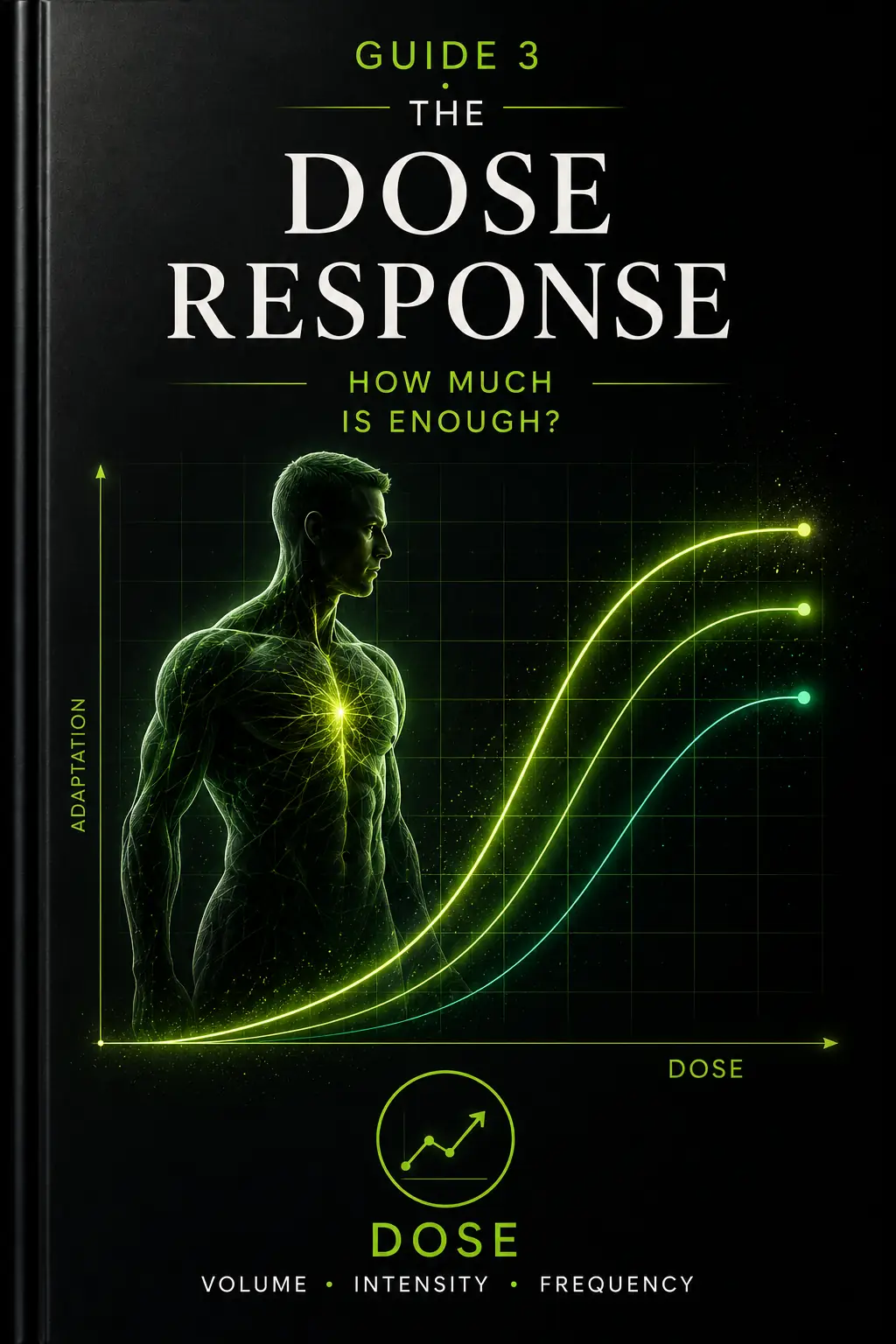
Dose-Response
How much training is enough — volume, intensity, frequency, and when more becomes less.
Guide 4 · In the series
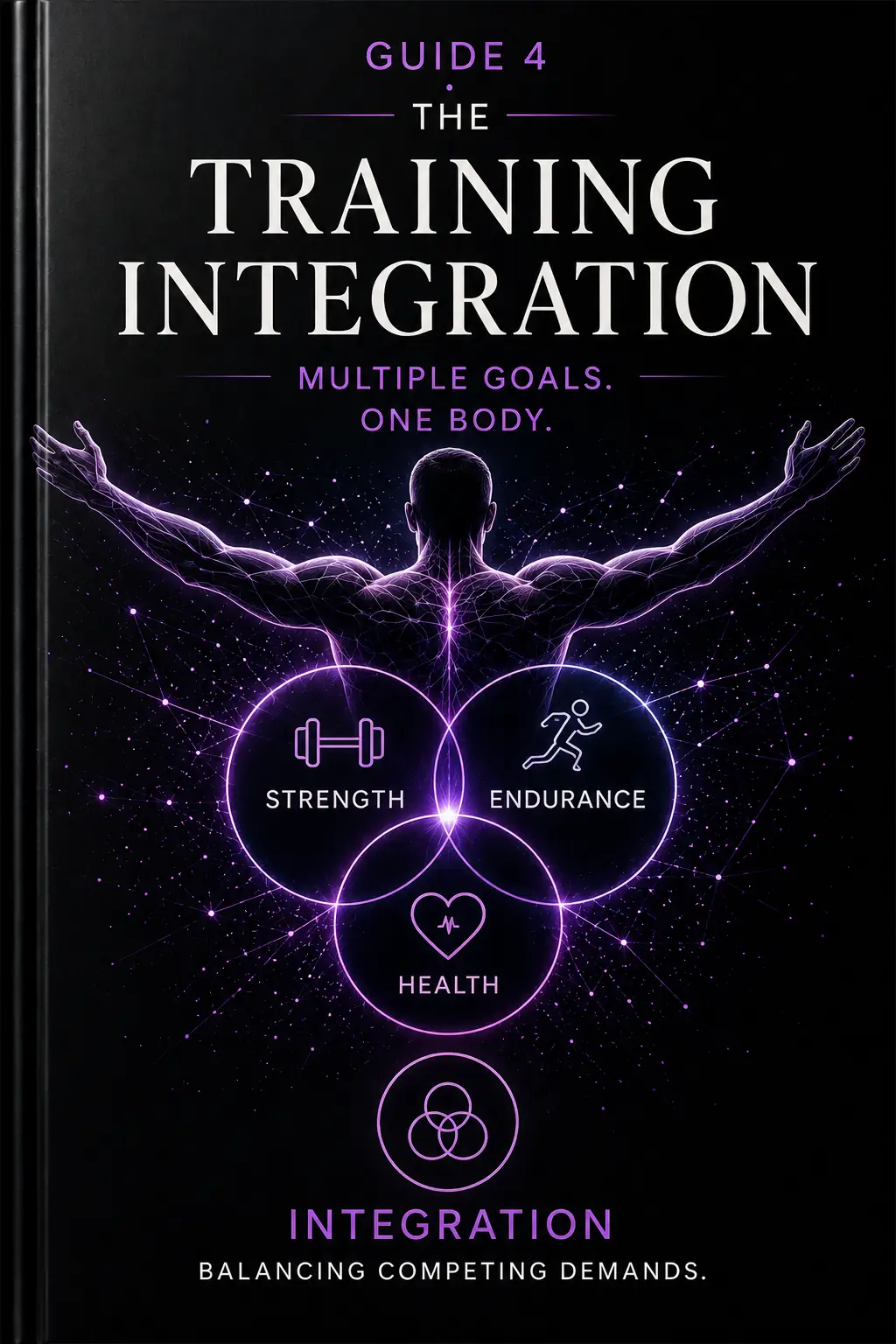
Training Integration
Multiple goals, one body — how to combine strength, endurance, and recovery coherently.
Guide 5 · In the series
Lifespan Adaptation
How training principles evolve with you — from youth through the master years.
The Movement System · Guide 2
Energy Systems
Six modules on how your body powers movement. Module 1 is free. The full guide unlocks for $10.
The Modules
 Free
FreeModule 1 · Free to all
ATP
The universal energy currency
Every movement runs on one molecule — and you can store almost none of it. Why the three energy systems exist, and what they are all racing to regenerate.
Module 2
Instant Power
The phosphocreatine system
Zero to maximum in milliseconds — the fastest energy system in your body, and the most limited. Why sprinters and powerlifters rest five minutes between efforts.
Module 3
The Burn
The glycolytic system
The sensation every hard set produces — now you will know exactly what it is. The truth about lactate, and why the burn is the system doing its job.
Module 4
The Endurance Engine
The oxidative system
Slow, efficient, inexhaustible — the aerobic base on which everything else depends. Mitochondria, fat versus glucose, and why marathoners look the way they do.
Module 5
The Continuum
How the three systems blend
The systems never work alone. Every effort is a blend — a dimmer switch, not a light switch. Why intensity, not choice, decides which system leads.

Module 6
Training the Systems
Knowledge into application
Every energy system has a precise training method — and precise parameters that produce it. Intensity, duration, and rest, set deliberately for the system you want.
Modules 2–6
You've seen Module 1. Unlock the rest of the guide.
$10
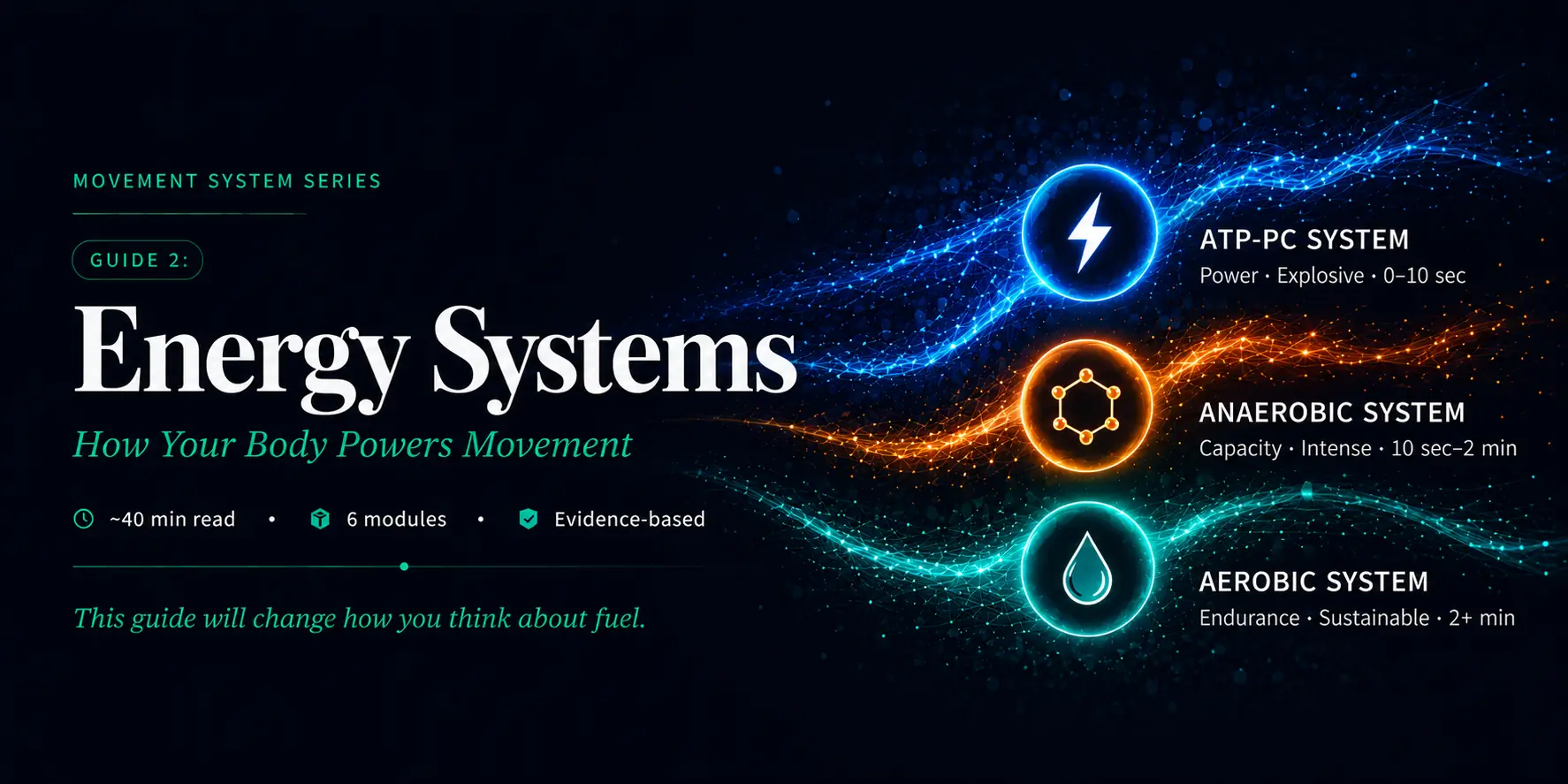
Guide 2 of 5 · The Movement System
Energy Systems
How Your Body Powers Movement
01You sprint 100 metres.
02Within seconds, you're completely spent.
03You jog for an hour at an easy pace.
04You could have kept going much longer.
Same muscles. Same body. Why?
The answer isn't in your muscles. It's in how your body produces energy to power them — and it has three completely different ways of doing it.
This isn't a detail for physiologists. It is the reason sprinters and marathoners train differently, the reason the same exercise feels different depending on how you perform it, and the key to matching your training precisely to your actual goals.
Six Modules
Every movement runs on one currency — and three systems that race to regenerate it.
- 01ATP is the universal fuel — and you can store almost none of it.
- 02The phosphocreatine system delivers instant power for seconds.
- 03The glycolytic system fuels intense efforts — and creates the burn.
- 04The oxidative system sustains effort for hours — the aerobic base.
- 05All three blend on a continuum — never working in isolation.
- 06Each system is trained by a precise method you can choose.
Master these, and every training decision becomes an energy system decision you make on purpose — not by accident.
Begin Module 1 — ATP →
Free · No signup required
Prefer to see the full guide first? View all six modules →

You have probably been told that exercise burns calories. It is true, in the way that saying a car burns money is true — accurate at a distance, useless up close. Your muscles cannot contract on calories any more than an engine turns on a bank balance. Between the food you eat and the movement you produce sits a single molecule that does the actual work, and every other thing your body does with fuel exists only to keep that molecule available.
Its name is ATP — adenosine triphosphate. Every muscle contraction, every nerve impulse, every cellular process you will ever perform is paid for in ATP and nothing else. You don't burn calories to move. You burn ATP. Calories, carbohydrate, fat, oxygen — all of it is raw material your body converts, through different routes, into more of this one currency.
Understanding ATP is not a detail for biochemists. It is the foundation the rest of this guide is built on. Once you see movement as a constant transaction in a currency you can barely store, the three energy systems stop being abstract biology and become the obvious, necessary answer to a problem your body solves every second you are alive.
How a Molecule Becomes Movement
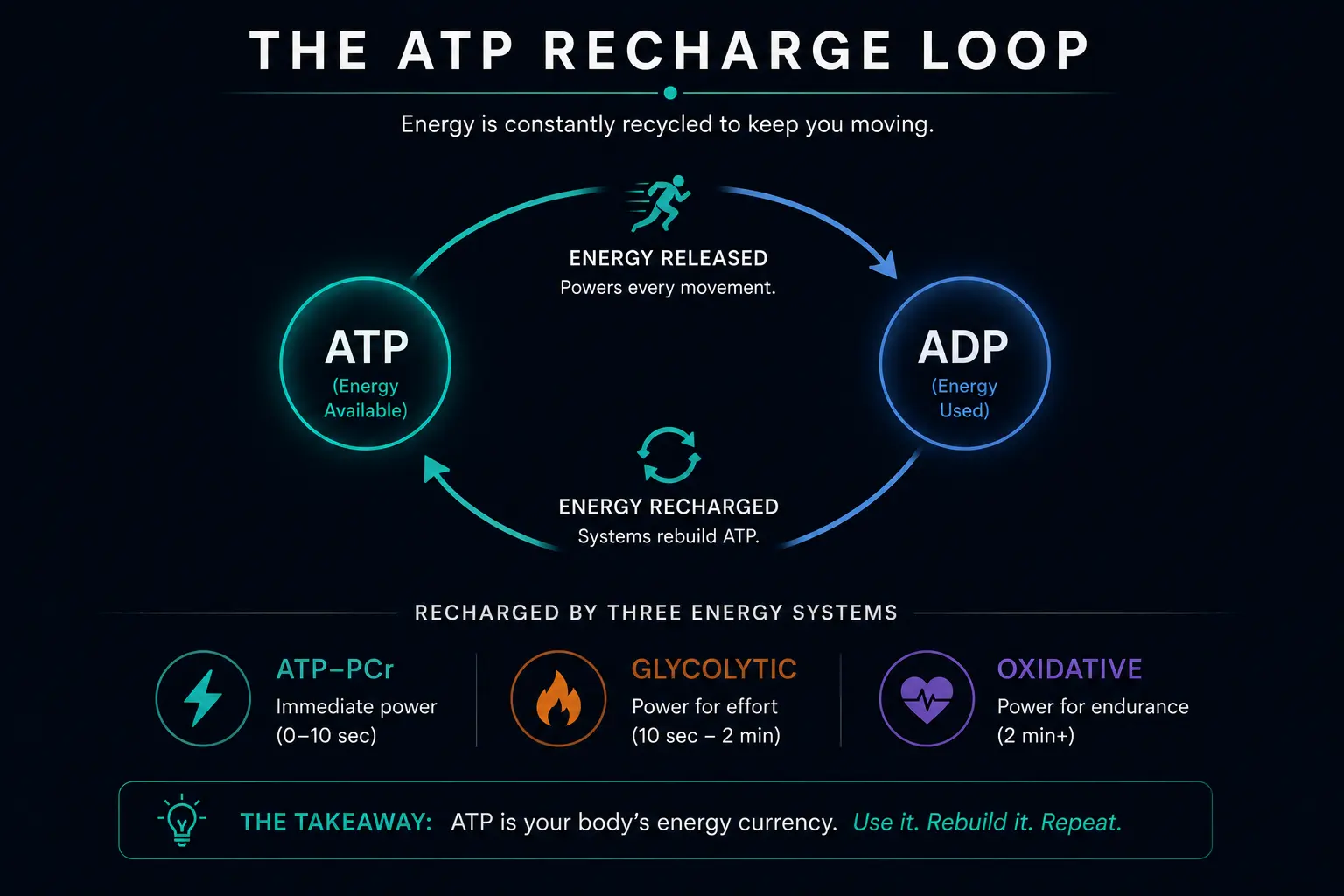
ATP carries its energy in its structure. The molecule holds three phosphate groups, and the bond securing the outermost one is where the usable energy lives. When a muscle needs to contract, an enzyme cleaves that bond. The third phosphate breaks away, energy is released to drive the contraction, and what remains is a depleted molecule — ADP, adenosine diphosphate, now carrying only two phosphates.
That single reaction is the engine of all human movement. But notice what it leaves behind: a spent molecule and a loose phosphate. Run that reaction across millions of fibres, thousands of times a second, and you would empty your entire ATP supply almost instantly — unless something were continuously putting the molecule back together. Something is. The spent ADP does not get discarded; it gets recharged. Reattach a phosphate group, and ADP becomes ATP again, ready to power the next contraction.
This is the rhythm beneath everything: spend, recharge, spend again. Energy released, energy restored, in an unbroken loop for as long as you keep moving.
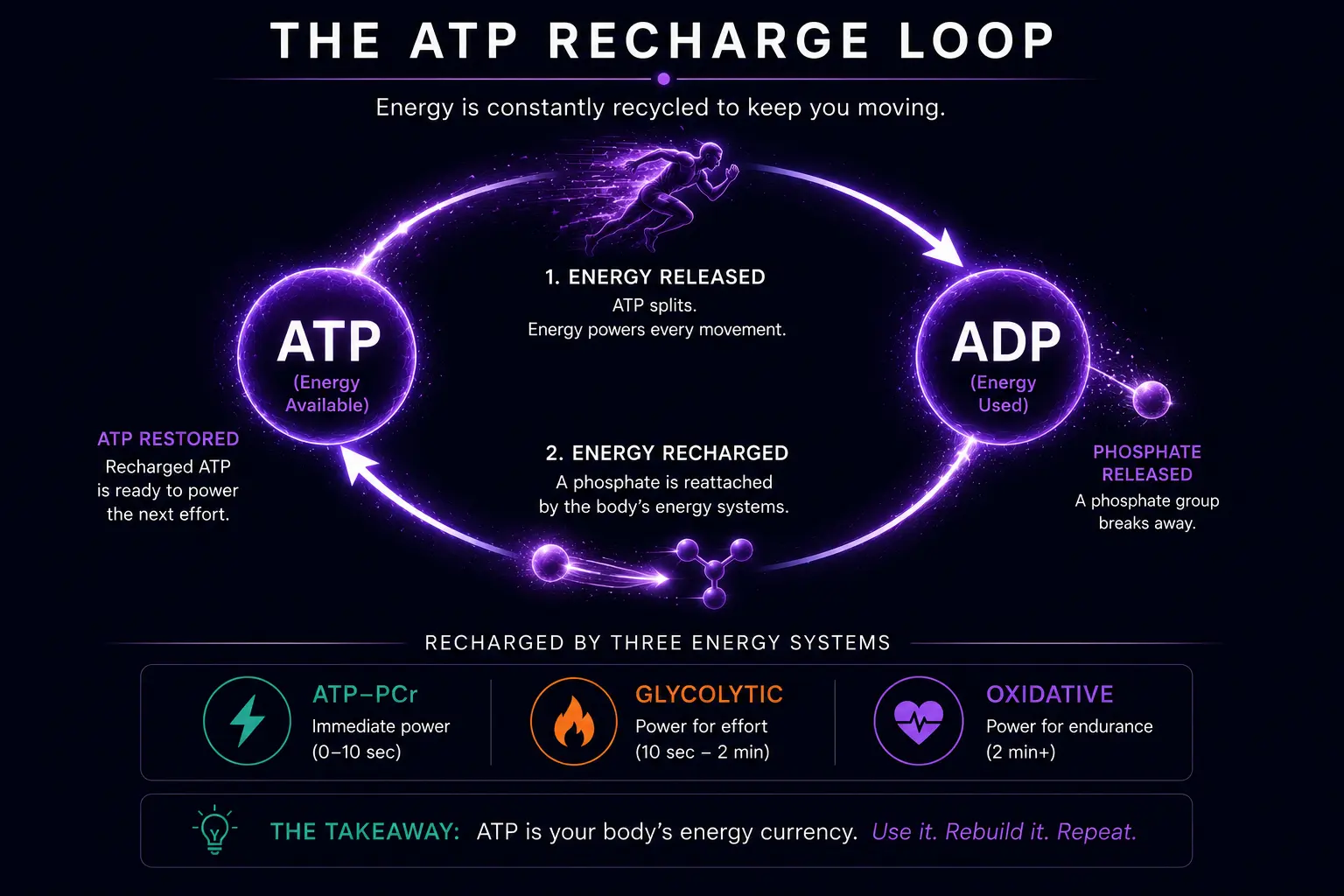
The loop in the figure never stops turning, and that is the whole point. There is no moment during exercise when your body is simply "using up" energy and waiting to refill — release and restoration happen at the same time, continuously, the way a bucket with a hole stays full only because water keeps pouring in. The instant restoration can no longer keep pace with use, the contraction weakens. Fatigue, at its root, is the loop falling behind.
Which raises the obvious question. If the loop is this important, why doesn't the body simply keep a large reserve of ATP on hand — a full tank to draw down at leisure? The answer is the most surprising fact in this module, and it changes how you should think about every hard effort you have ever made.
The Fundamental Principle
You cannot store meaningful amounts of ATP. Your entire body holds only enough for roughly one to two seconds of all-out effort.
The loop is not a convenience. It is a necessity — the only thing standing between you and an immediate stop.
One to two seconds. Not minutes, not a reserve you can ration — barely a heartbeat of maximal work before the stored supply is gone. The total amount of ATP in an adult body at any instant is only about five grams. You spend and remake your own body weight in ATP over the course of a single hard day, not because you carry that much, but because the same few grams cycle through the loop thousands of times.
The figure below sets that tiny supply against the relentless demand of actual movement. The mismatch is not small. It is the central problem your physiology is built to solve.
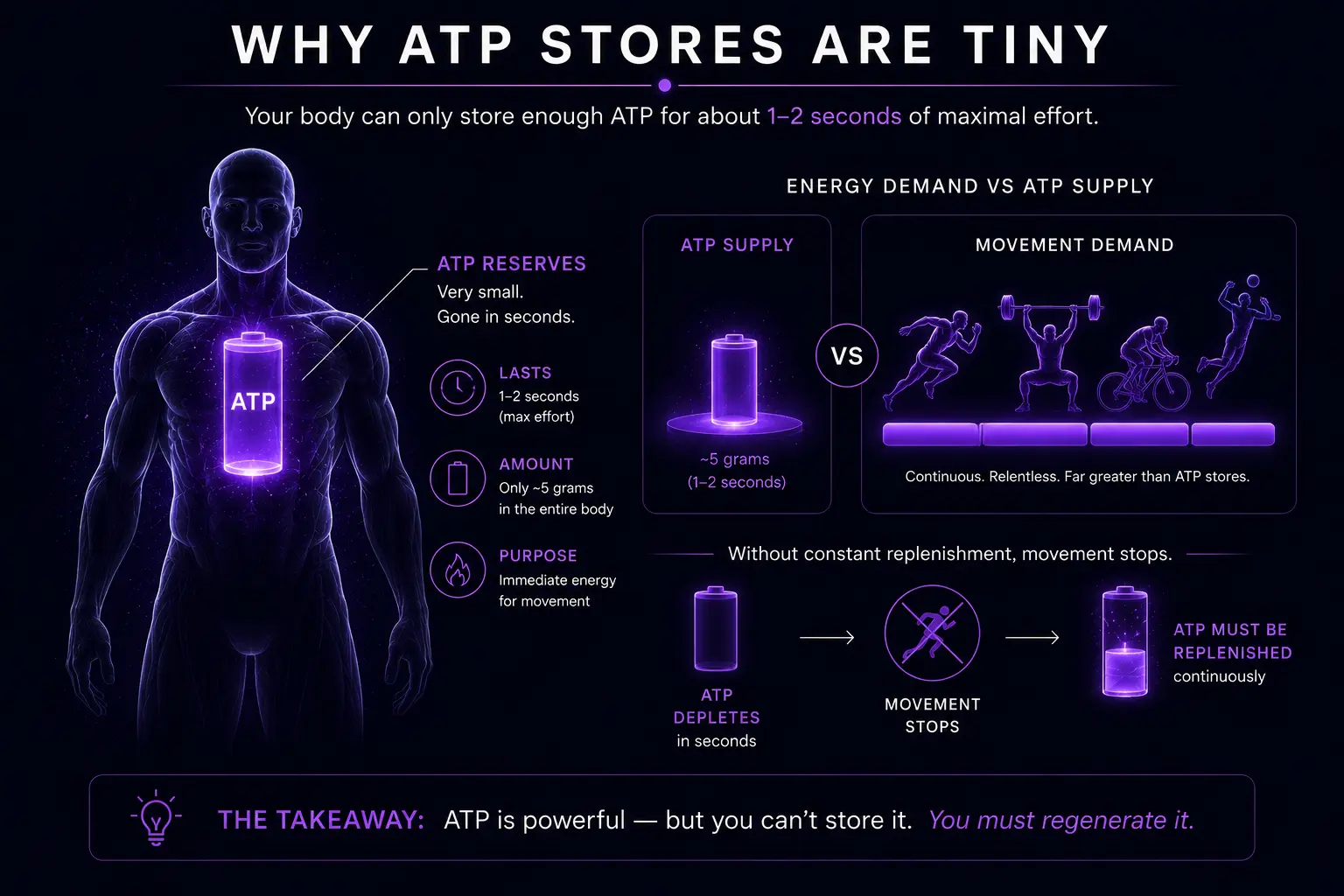
Seen this way, the design makes sense. Carrying a large ATP reserve would be enormously heavy and metabolically expensive, and it would still buy you only a little more time before you faced the same problem. Evolution chose the smarter solution: store almost nothing, and build fast, reliable machinery to remake the molecule on demand. The body does not bank energy. It manufactures it, continuously, at the exact rate movement requires.
So the real question of training physiology is not "how much energy do you have?" It is "how fast can you remake it?" And here the body does something elegant. It does not rely on a single method of regeneration. It has three — each a different way of reattaching that phosphate to turn ADP back into ATP, and each suited to a different kind of demand.
They differ along three axes, and those three differences will explain nearly everything in the rest of this guide:
- How fast they can regenerate ATP — instant, fast, or steady.
- How long they can keep it up — seconds, minutes, or hours.
- What fuel they burn to do it — stored phosphate, glucose, or fat.
A short, explosive effort needs ATP remade instantly, with no time for chemistry. A sustained hard effort needs it remade quickly, and can tolerate some complexity and some cost. A long, moderate effort needs it remade efficiently, where staying power matters more than speed. Three demands — and, conveniently, three systems, each built to meet one of them. The figure introduces all three at once.
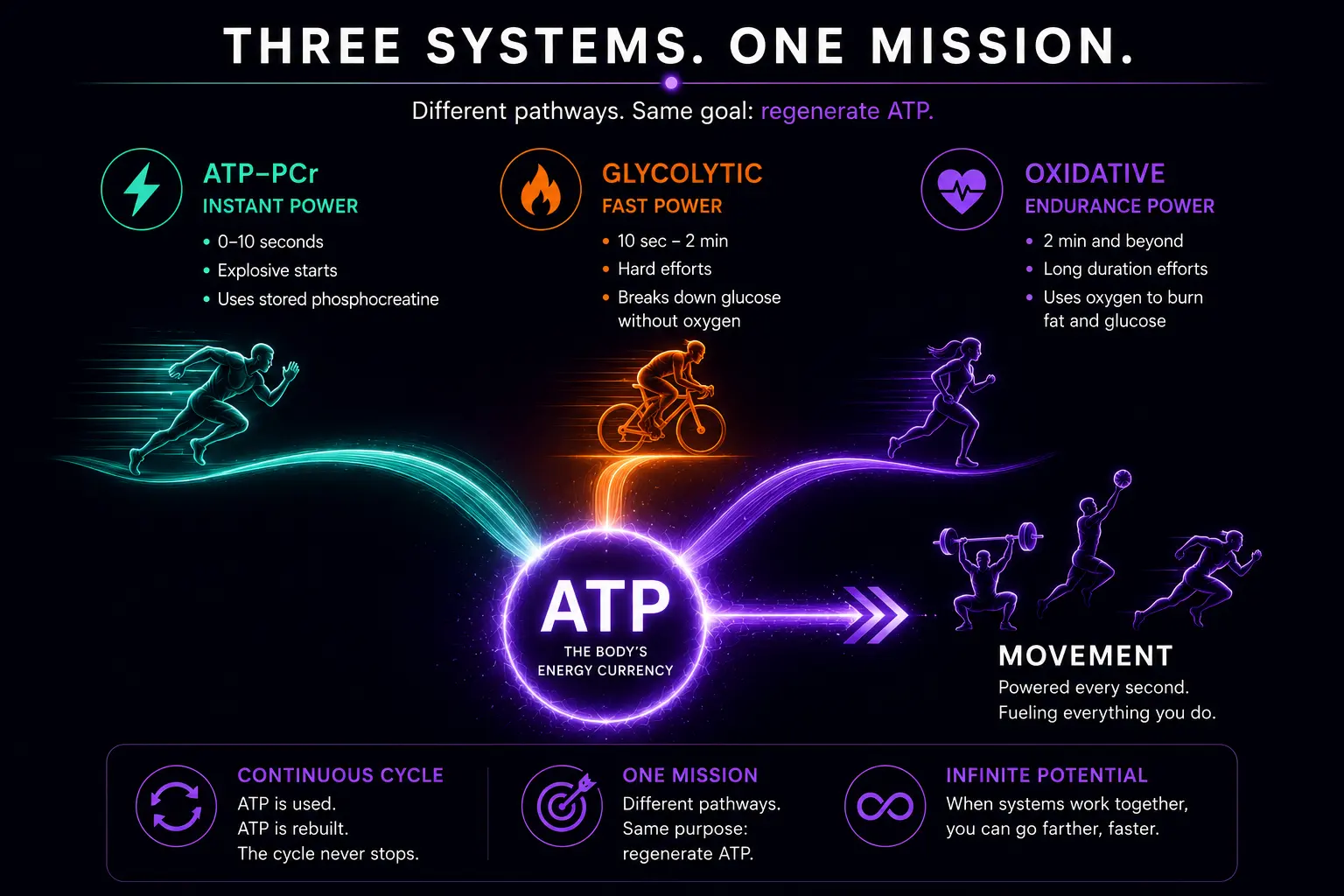
Hold onto the structure in that figure, because the next three modules are simply a closer look at each branch of it. The phosphocreatine system delivers instant power for the first seconds of any maximal effort. The glycolytic system takes over for hard work lasting up to a couple of minutes — and produces the burn you know from a brutal set. The oxidative system sustains everything beyond that, using oxygen to extract enormous amounts of ATP from fat and glucose for as long as you care to keep going.
What unites them is more important than what separates them. Three different pathways, three different fuels, three different timescales — but one mission, shared without exception: keep ATP available so the contraction can repeat. No matter the intensity, the duration, or the sport, the goal never changes. Everything that follows in this guide is a variation on this single theme.
And this is why the way you train is never neutral. Every session you perform places its heaviest demand on one of these three systems — and the system you stress is the system that adapts. Choose short and maximal, and you train the phosphocreatine system. Choose hard intervals, and you train glycolysis. Choose long and steady, and you build the oxidative engine. You are always casting a vote for one system over the others, whether you intend to or not.
Every training decision is an energy system decision. You are always choosing which system to stress — whether you know it or not.
Modules 2–6
You've seen Module 1. Unlock the rest of the guide.
$10